
Built Minds – 03 | Lina Bo Bardi

Architecture as a Social Act

Why Lina Bo Bardi?
Lina Bo Bardi believed architecture should not impress—it should belong.
At a time when modernism was often associated with power, control, and monumentality, Bo Bardi redirected architectural thinking toward everyday life, collective use, and social inclusion. Her work challenges the idea that architecture exists for elite taste or isolated contemplation.
For Built Minds, she represents a critical shift:
architecture not as an object, but as a social instrument.
A Life Between Cultures
Born in Italy in 1914 and later moving to Brazil, Lina Bo Bardi’s architectural identity was shaped by displacement, adaptation, and cultural hybridity. Rather than imposing European modernism onto a new context, she absorbed Brazilian social life, vernacular traditions, and informal spatial practices.
Her work emerged from observation, empathy, and political awareness.
Architecture, for Bo Bardi, was inseparable from people and place.
The Architectural Thinking Behind Bo Bardi
Architecture for Everyday Life
Bo Bardi rejected architecture as a distant, untouchable artifact.
She designed spaces to be occupied, transformed, misused, and reinterpreted by people.
Use was more important than image.
Roughness as Honesty
Exposed concrete, reused materials, and unfinished details were not aesthetic gestures—they were ethical decisions.
Her architecture embraced imperfection as a reflection of real life.
Collective Space Over Monument
Rather than iconic forms, Bo Bardi focused on generous, flexible public interiors where social interaction could unfold naturally.
Architecture became a framework for coexistence.

Key Projects
SESC Pompéia – São Paulo
An old factory transformed into a vibrant social and cultural center.
Sports, art, leisure, and daily life coexist without hierarchy. The project stands as a manifesto for inclusive public space.
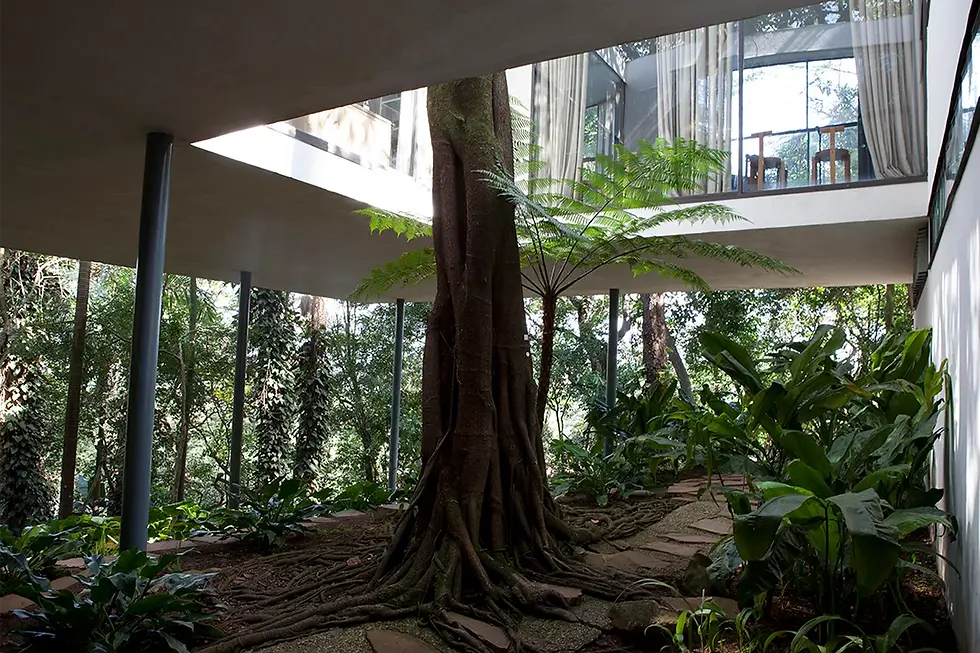
Glass House – São Paulo
Her own residence, suspended lightly within nature.
Transparent, open, and intimate—this house reflects her belief in architecture as a mediator between life and environment.
MASP – São Paulo Museum of Art
A bold structural gesture creating an open public plaza beneath.
Here, architecture physically gives space back to the city.
Our Perspective
Lina Bo Bardi reminds us that architecture is always political—even when it claims neutrality.
Her work is especially relevant today, as cities struggle with inequality, privatization of public space, and loss of social cohesion. She demonstrates that strong architecture does not require excess budget or iconic form, but clarity of intention.
For contemporary practice, her legacy encourages us to ask a fundamental question:
Who is architecture really for?
Thoughts
Architecture gains meaning when it allows life to happen freely.
Without people, space is only geometry.


Comments