
Built Minds – 05 | Louis Kahn

Structure, Meaning and the Search for Timelessness
Why Louis Kahn?
Louis Kahn did not ask how a building should look.
He asked what it wanted to be.
In contrast to the efficiency-driven logic of modernism, Kahn reintroduced questions of meaning, permanence, and presence into architecture. His work stands at the intersection of modern construction and ancient sensibility.
For Built Minds, Kahn represents the moment when architecture regained its philosophical depth.
A Late but Profound Career
Born in 1901, Louis Kahn’s most influential work emerged relatively late in his life. This delay was not weakness—it was incubation.
He spent decades questioning architecture’s purpose, studying ruins, and reflecting on how buildings communicate beyond function.
Kahn was not interested in novelty; he pursued inevitability.
His architecture feels discovered rather than invented.

The Architectural Thinking Behind Kahn
Served and Servant Spaces
Kahn clearly separated primary spaces from supporting systems.
Structure, circulation, and services were not hidden—they were expressed as part of the architectural order.
This clarity gave buildings legibility and dignity.
Structure as Expression
Columns, beams, and walls were not merely technical solutions.
They were the language of the building.
For Kahn, structure was the first act of architecture.
Light as the Maker of Space
Kahn famously said: “The sun never knew how great it was until it hit the side of a building.”
Light reveals form, material, and intention—transforming construction into architecture.

Key Projects
Salk Institute – La Jolla
A monumental courtyard framed by laboratories.
Science meets contemplation; precision meets silence. Few buildings balance rigor and poetry so effortlessly.
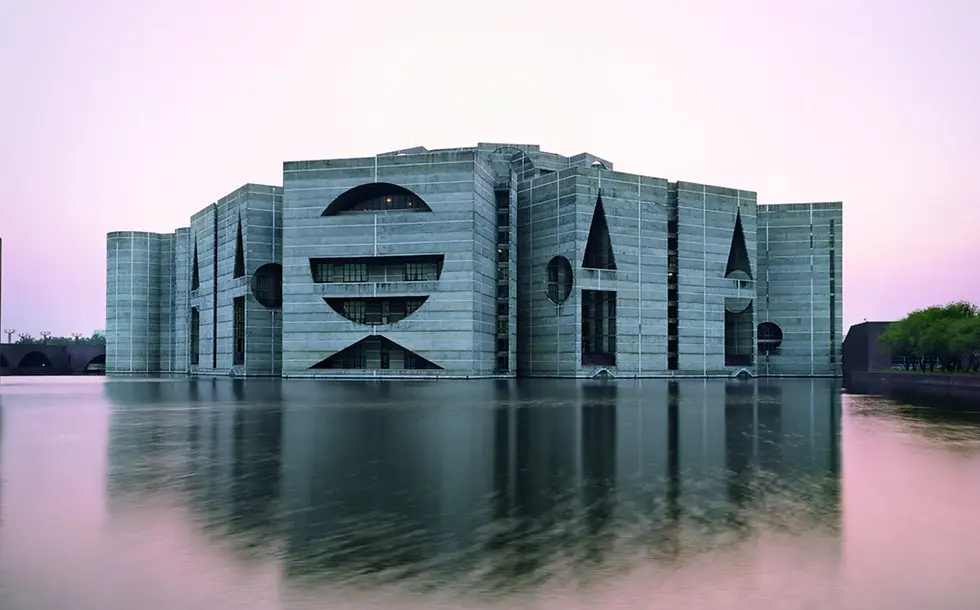
National Assembly Building – Dhaka
A powerful civic structure defined by geometry, mass, and light.
Here, architecture becomes an expression of collective identity.
Kimbell Art Museum – Fort Worth
A masterclass in daylight control.
Vaulted forms transform light into a spatial rhythm, proving that simplicity can be profound.
Our Perspective
Louis Kahn teaches us that architecture gains strength when it is grounded in purpose rather than image.
In today’s climate of rapid production and visual overload, his work feels almost radical. He reminds us that buildings must speak not only to the present, but to the future—and even to history.
For contemporary practice, Kahn’s question remains essential:
Before designing how a building looks, we must understand what it wants to be.
Thoughts
Architecture endures when structure, light, and meaning align.
Everything else fades with time.


Comments